
Long before winding roads carved through Macon and Jackson counties, this land was sacred to the Cherokee. Their towns – Cowee, Nikwasi, and others – were spiritual and political centers. Cowee, nestled in present-day Macon County, was once the capital of the Middle Cherokee. Explorer William Bartram, who trekked across the Plateau in 1776, called it “one of the most charming natural mountainous landscapes anywhere to be seen.”
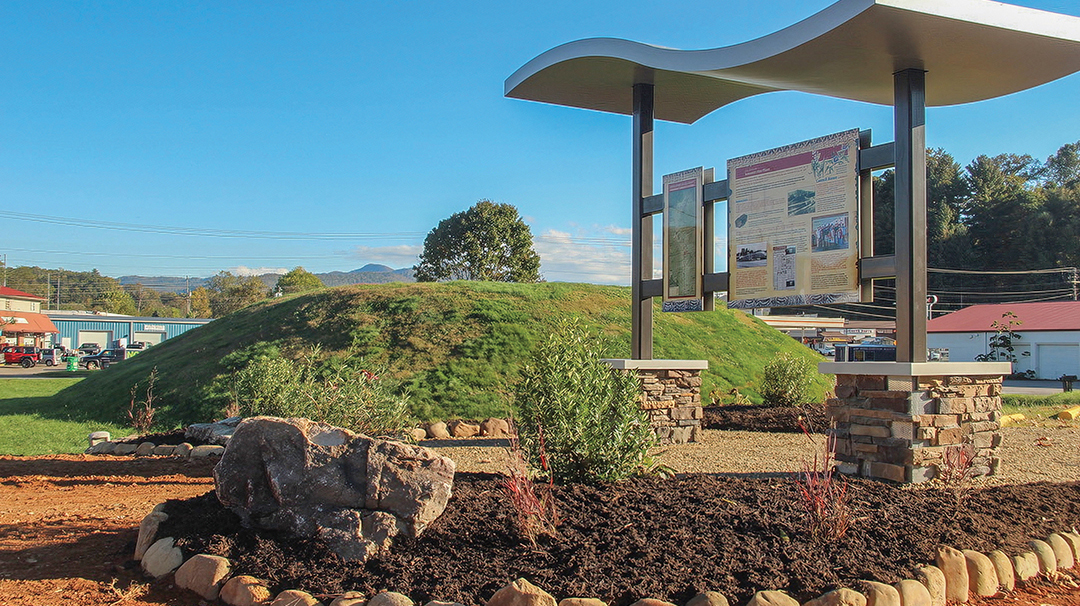
The Nikwasi Mound, still visible in Franklin, marked the heart of a thriving town. By the mid-18th century, colonial expansion pressed in. Treaties like Hopewell (1785) and Holston (1791) attempted to define boundaries, but settlers often ignored them. “We are determined to have our land,” a Cherokee leader declared, “and will not suffer white people to take it from us.”
During the Revolutionary War, the Cherokee allied with the British, hoping to preserve their territory. In retaliation, General Griffith Rutherford led a brutal campaign in 1776, burning over 50 Cherokee towns—including Cowee and Nikwasi. A settler wrote, “The smoke of their villages hung in the air like a mourning veil.”
Southern Jackson County, though less documented, was part of this contested borderland. After the Treaty of 1819, settlers flooded the Tuckasegee River valley, and the Cherokee were forced to cede vast tracts of land—often under duress.
Yet the Cherokee endured. They rebuilt towns, preserved traditions, and resisted removal. “We are the people of the mountains,” said a Cherokee elder in 1810. “Our stories are in the stones and the wind.” Even as the Trail of Tears loomed, some remained, forming the Eastern Band that still calls Western North Carolina home.
When we lived in Whiteside Cove, my son and I often hiked to Granite City and the Whiteside Trail. The Cherokee lore surrounding these are steeped in mystery and reverence. Known as Sanigilâ’gĭ, Whiteside Mountain’s gleaming quartzite cliffs inspired its name—“like a sheet of ice.”
One legend tells of a stone bridge that once connected Whiteside Mountain to the Hiwassee River, destroyed by lightning in a divine act. Another tale speaks of Spearfinger, a stone-skinned monster who preyed on children. Her razor-sharp finger was her weapon, her heart hidden in her right hand. Guided by a chickadee, the Cherokee struck her down.
Granite City’s massive boulders, though less prominent in lore, were likely part of the sacred geography. These stories weren’t just myths—they were moral lessons, warnings, and cosmological maps. Even today, hikers report a strange stillness, a sudden chill. The Cherokee believed the land remembers—and sometimes, it speaks.


Favorites Count: 0