
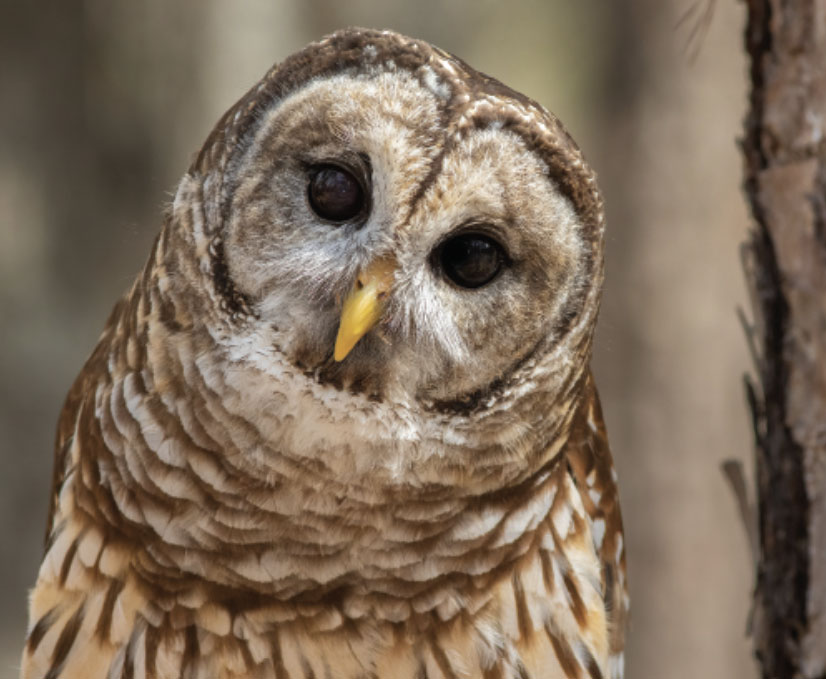
For some unknown reason, I’ve become increasingly interested in owls. I hadn’t given them much thought before, but I’ve always appreciated their evening calls. They feel like little sentries, keeping watch over me and my woods during the dark hours.
Barred owls are around all year, but late winter and early spring are when they’re most likely to make themselves known. They don’t migrate or hibernate—just quietly live their lives, hunting and moving through the trees. What changes is how often we hear them.
March is their time to call out more, pairing up, defending territory, and staking out nesting sites. That’s why, even though they’re active year-round, this month they seem impossible to ignore.
Their call is what gives them away. It isn’t a novelty; it’s how barred owls communicate. Sometimes you’ll hear two owls calling back and forth, their voices overlapping in what can sound like an argument or a conversation. I once assumed the calls were random, but they’re very purposeful.
They prefer mature woods with plenty of cover and access to water, which makes our mountain terrain, with its creeks and dense forests, just about perfect. Though large, they’re surprisingly good at staying hidden, especially during the day. They are rarely seen, and that’s part of their charm. If you’re lucky, you may spot one perched silently on a branch at dusk, wide-eyed and watchful. Mostly, though, they remain unseen, known only by sound.
Barred owls are flexible hunters. Most active at dusk and dawn, they may hunt on cloudy afternoons. Their diet is varied—small mammals, birds, frogs, insects, even crayfish. If it moves and fits, a barred owl will likely consider it food. March also marks the beginning of nesting season. Barred owls don’t build nests of their own; they rely on natural tree cavities, old hawk or crow nests, or hollow trunks. I never paid much attention to old trees until I realized how much they matter to wildlife like this.
One of the most interesting things I’ve learned is how comfortable barred owls can be around people. While still wild and deserving distance, they’ve adapted well to life near homes, farms, and quiet neighborhoods. Many of us have shared space with the same pair for years without realizing it.
Even when the garden is still asleep and the ground feels cold, these owls are busy with their own spring routines. I’ve started the habit of stopping some nights to listen for them. Their conversation rolls through the trees, fades, and then comes again from another direction—a reminder that life is already moving all around us, whether we notice or not.
And somehow, knowing the barred owls are out there, calling to one another in the dark, makes the wait for spring feel a little easier.
Happy owl watching!


Favorites Count: 0