
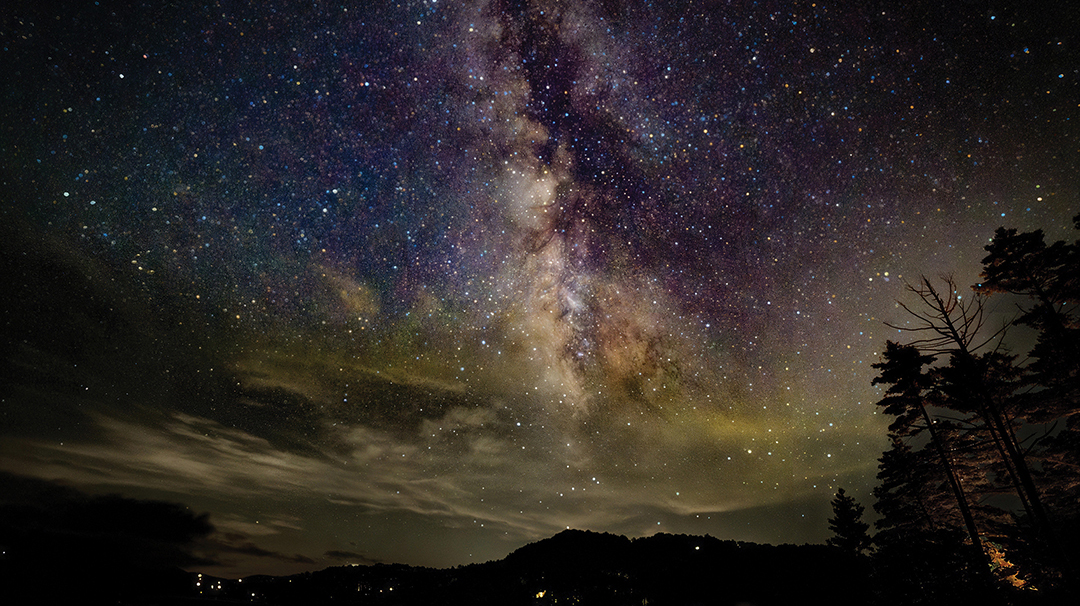
 When the sun drops behind the Plateau, we’re used to a particular kind of quiet – crickets in the grass, a cool mountain breeze, and, on a good night, a sky dense with stars. But across the country, that darkness is getting harder to find.
On May 19, Highlands-Cashiers Land Trust will bring the issue into focus with an engaging Village Nature Series program: “Embracing the Dark: Light Pollution, Health, and the Environment,” presented by astronomer and educator Stephan Martin at the Cashiers Village Green.
For more than a century, artificial lighting has steadily pushed back the night – brightening streets, homes, and businesses, while quietly changing the lives that depend on darkness.
Researchers now link excessive nighttime illumination to disrupted wildlife behavior, increased energy use, and sleep-cycle interference in humans. The result isn’t just a washed-out sky; it’s a shift in the natural rhythms that have guided ecosystems (and our bodies) for millennia.
Martin’s presentation will look at the science behind dark skies and the very real consequences of losing them. Expect an accessible tour through the ways light at night can disturb animal migration and feeding patterns, and how the wrong light at the wrong time can interfere with human rest and recovery.
Just as importantly, the talk reframes darkness as something worth protecting – an environmental resource as vital as clean water or healthy forests.
The good news: restoring the night doesn’t require living off-grid. Attendees will come away with straightforward steps for homes and neighborhoods – shielding fixtures so light points down, choosing warmer bulbs, using timers and motion sensors, and turning lights off when they aren’t needed. Small changes can reduce glare, cut utility costs, and make evenings more comfortable for people and wildlife alike—while giving the stars a chance to return.
A seasoned astronomer, educator, and author, Martin has spent more than three decades teaching astronomy, physics, and sustainability, and he’s worked behind the scenes of world-class science as an instrument specialist for the Hubble Space Telescope.
He also served as Observatory Supervisor at Williams College and joined international eclipse expeditions to study the sun’s corona. Today, his programs combine practical insight with a sense of wonder – inviting audiences to reconnect with the natural world by looking up.
The Village Nature Series program is free and family-friendly, held rain or shine, and no reservations are required. Come early, bring a chair if you’d like, and consider lingering afterward to test your newly tuned “night vision.” (Thank you to Cedar Creek Club for sponsoring the Village Nature Series.)


Favorites Count: 0