
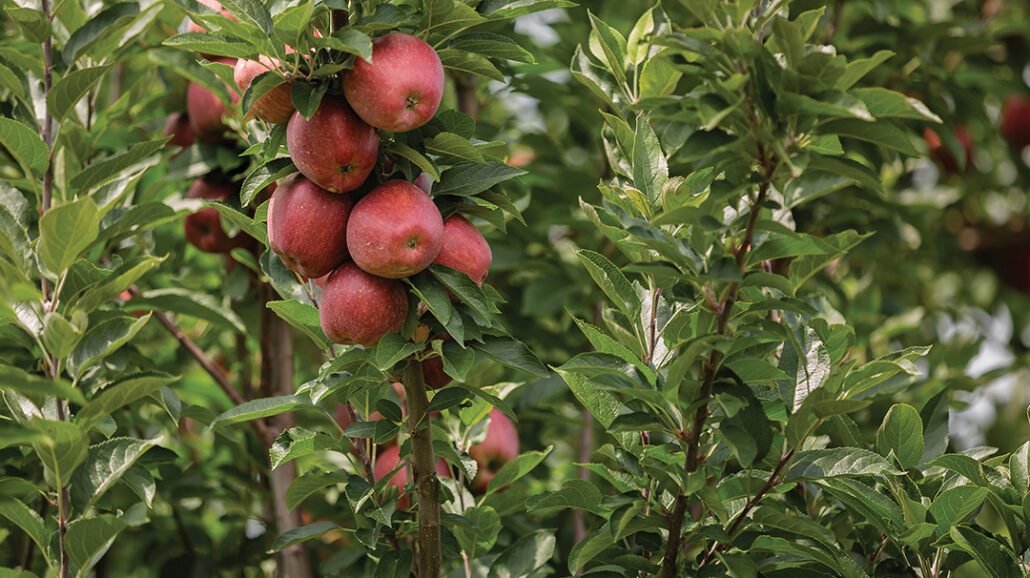
A couple of years ago, I wrote about the rare Arkansas Black Apple Trees thriving on the grounds of The Bascom. Such an exotic heritage variety—how on earth did they end up on the Highlands-Cashiers Plateau? I tried to pin down the truth, but their arrival remains a mystery.
A bit of snooping through old journals and correspondence with passionate apple historians (who knew?) revealed that the Plateau has a history of hardy apples grown here and nowhere else. Two rare apple varieties—Cullasaja and Junaluska—tell a story of Cherokee heritage, horticultural ingenuity, and the quiet persistence of the land.
The Cullasaja apple, also known as Winter Horse or Callasaga, first took root in the 1830s when Nancy Bryson planted a seed near the Cullasaja River in Macon County. Its tough, russeted skin and aromatic flesh made it a prized dessert apple. The variety caught the attention of Silas McDowell, a polymath and horticulturalist who lived in the old Cherokee village of Sugartown, near present-day Highlands. McDowell introduced the apple to the pomological world in 1850, praising its resilience and flavor. Though it faded from orchards by the mid-1900s, it was rediscovered in 1989 by apple historian Lee Calhoun, who found a lone tree still clinging to life in Macon County—its roots deep in the soil of memory.
The Junaluska apple carries the name of Chief Junaluskee, the Cherokee leader who helped Andrew Jackson win the Battle of Horseshoe Bend. Though his land grant was later revoked, Junaluskee returned to reclaim his Cheoah property, where the apple tree stood. McDowell again played a pivotal role, cataloging the Junaluska in the 1850s and propagating it from cuttings. With its dense, subacid flesh and russeted skin, the Junaluska was a late-season treasure, used for fresh eating and cider. Thought extinct for over a century, it was rediscovered in 2001 by apple hunter Tom Brown, just eight miles from McDowell’s historic orchard.
Today, neither apple is grown commercially in Macon or Jackson counties, but both survive through the efforts of heritage orchardists and apple preservationists. Their stories are more than agricultural footnotes—they are living heirlooms of the Plateau’s cultural and botanical heritage. They whisper of Cherokee stewardship, McDowell’s quiet genius, and the region’s enduring connection to the land.
In Highlands, where McDowell’s writings on the “thermal belt” inspired businessmen like Samuel Kelsey and Clinton Hutchinson to plant orchards and promote the area as a health resort, the Cullasaja and Junaluska apples remain symbols of resilience. Their revival is a testament to the power of memory, and a call to preserve the fruits of history before they fall from the tree of time.


Favorites Count: 0