
The former Cleaveland’s Grocery is just one of seventeen buildings on a new audio tour of the Town of Highlands created by the Highlands Historical Society to celebrate the 150th Anniversary of the founding of Highlands.
William B. Cleaveland is regarded as one of Highlands’ most important pioneers. He arrived in Highlands from Bridgeport, Connecticut, in 1881 after doctors recommended mountain air as a treatment for his breathing troubles. He and his family were some of the first settlers in Highlands, which had only recently been founded in 1875. He constructed a new building on Main Street where Spartina is currently located in 1885 in which he ran a highly successful grocery store.
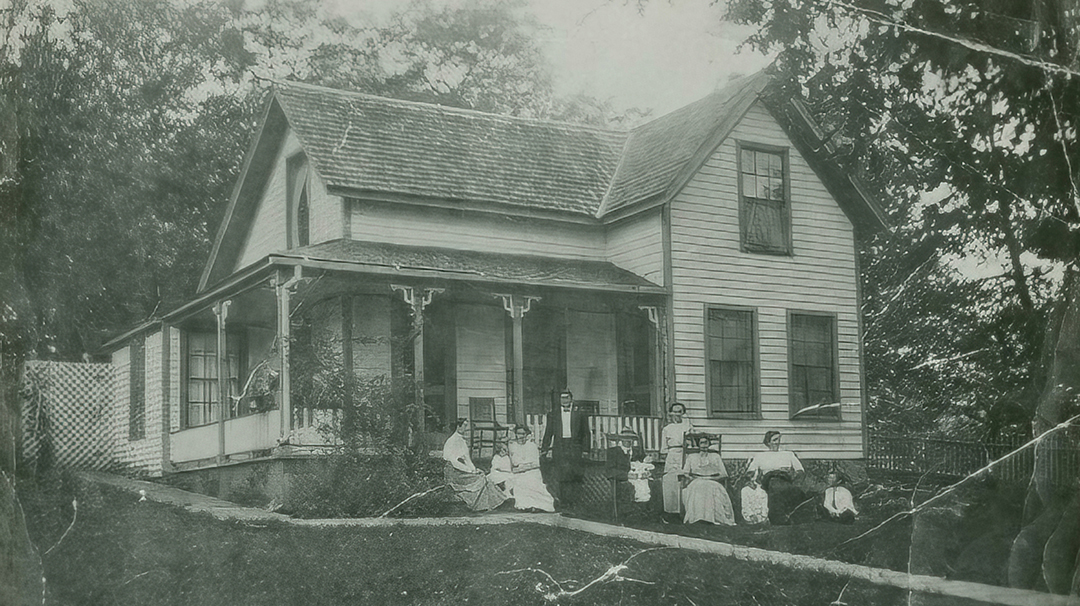
Cleaveland and his wife, Ida Estelle “Stell” Cleaveland, lived at the McGuire House on 4th Street before buying the land directly across Main Street where there is now a grassy knoll shaded by a giant maple just beyond the Loafers Bench. A one-and-a-half-story multi-gabled house, including a wrap-around porch, was built and finished in 1888.
However, William B. Cleaveland would not live long enough to fully enjoy his newly built structure, as he died in 1893 from pneumonia, leaving behind Stell and seven children. Estelle lived in the house and maintained its upkeep until the grocer Harvey Talley bought the property and moved in during the mid-1940s.
One of the Cleaveland’s sons, Will, became a renowned contractor who built many of the structures that you now see in downtown Highlands.
Unfortunately, the Cleaveland home became neglected and deteriorated with time and was recently torn down.
When he died, Cleaveland also left behind his acclaimed rock and Native American relics collection which Will donated in 1927 to help establish the Highlands Museum, known now as the Highlands Biological Station and Nature Center. The collection consisted of over 2,500 artifacts, including beautifully carved arrow heads, pottery etched with Cherokee History, primitive peace pipes and tomahawks.
Many of the relics were acquired by Cleaveland in exchange for groceries at his store.
The Loafer’s Bench was commissioned by Ralph deVille in 1974 to replace the six loafer’s benches that Will Cleaveland had built there in 1922. The red Torii Gate, on the property behind the bench was made by Ron Weston in honor of deVille after his death, signifying entrance onto sacred ground. Over the years many a resident or visitor has relaxed peacefully on the Loafer’s Bench beneath the broad-shouldered maple which formerly fronted the Cleaveland family home.
Cleaveland’s Grocery was among the first of several establishments that sold groceries and general goods from the building in the late 1800’s. After Cleaveland’s death, the grocery changed hands to W. T. “Billy” Potts in 1902, who ran it until Charlie Wright, now famous for the rescue on Whiteside Mountain, turned it into a general merchandise store in 1914. Charlie’s slogan and advertisement was, “Come and See us Any Time and You’ll Buy Your Clothes Here All the Time!”
The site changed hands again in 1920, when Fred Edwards occupied the building with his very popular grocery store and sold merchandise there for 30 years, rivaling the Potts Brothers store next door. Even in the winter the big potbellied stove glowed for old-timers who sat with their backs to it, warming themselves as they told stories and shared local gossip, hound dogs asleep at their feet.
Steve Potts converted the grocery into his equally popular Steve’s Country Store in 1952. By 1986 the building was the site of Ann Jacob Gallery, the oldest gallery in the Southeast, and today it is occupied by Spartina 449. For almost 150 years, many a satisfied customer walked out of the doors of the old building. In many cases, their spouse awaited them on the Loafer’s Bench directly across the street.
You can learn more about this building and the sixteen others on the audio tour at any time of year. Maps are available at the Highlands Historical Village, the Chamber of Commerce Welcome Center or at the HHS website. The Village is open on Thursdays through Saturdays from 10:00 A.M. to 4:00 P.M. and on Sundays from 1:00 to 4:00 P.M. through November 16. Admission is free. Visit highlandshistory.com for more information.


Favorites Count: 0