
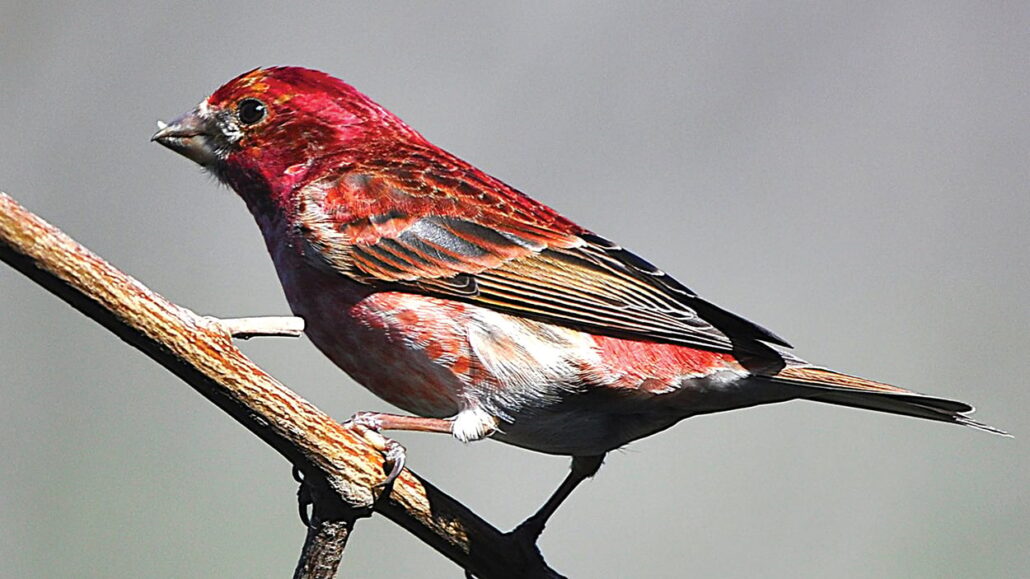
Male Purple Finch
A local migrant that winters in our area from December to May, this bird frequented our seed feeders in large numbers this past winter.
The Purple Finch, the state bird of New Hampshire, is a seasonal resident of the Highlands-Cashiers Plateau during winter months as flocks migrate to the Southeastern U.S. from Canada. That’s right, this short-distance migrant comes to our temperate rain forest for the winter.
Larger than a sparrow and smaller than a cardinal, the female Purple Finch is an elegant brown and white with bold streaks on her head, breast and belly, a white “brow” above the eyes and lower moustachial markings.
The male, described by Roger Tory Peterson as a “sparrow dipped in raspberry juice,” has a reddish wash over its head, back and wings.
Both have distinctive notched tails and triangular bills. There are slight differences between the eastern and western subspecies of this finch and the Purple Finch (Haemorhous purpureus) is not to be confused with a House Finch (Haemorhous mexicanus).
Their habitat is mixed and coniferous woodlands. During the summer Purple Finch feed on seeds, insects, berries and buds high in the trees. In winter they forage lower in the forest, searching for seeds, competing with other ground feeders.
Their breeding grounds are in Canada, California and the Northeastern U.S., ranging from Minnesota to West Virginia. They build their nests on horizontal branches and tree forks using twigs, grass and moss, creating well-shaped cups that are lined with animal hair and fine grass. The female lays and incubates four or five blue-green eggs with brown spots on the larger end. Hatchlings appear in about 13 days, fed by both parents until they fledge about two weeks after hatching.
Finch, like most other birds, sing little in the winter, foraging for food taking precedence over social activities. If they did sing, the song would be something like plidi tididi preete plidi tititi preer. Did you get that?! Check your Merlin app to hear a recording. They are often seen congregating with other finch and local winter birds around feeder stations offering sunflower seeds.
Happy May birding from the Highlands Plateau Audubon Society.
The Highlands Plateau Audubon Society, focused on enjoying and preserving birds and their habitats, is a Chapter of the National Audubon Society and a 501(c)(3) organization. For information on all our activities and membership, please visit highlandsaudubonsociety.org.


Favorites Count: 0