
If you’ve hiked the trail along the cliffs of Whiteside Mountain hopefully you’ve spotted swirling and soaring Peregrine Falcons. While majestic by many measures, perhaps most impressive are their stoops, the steep and spectacular dives in pursuit of prey that can approach 200 miles an hour, making the Peregrine Falcon the fastest animal on earth.
Highlands and Cashiers are located within the Blue Ridge Escarpment of the Southern Appalachian Mountains, commonly called the “Blue Wall.” Here erosion-resistant metamorphic mountains have created drastic elevation changes in very short distances, among the steepest in the United States. The extreme contrast in elevation causing passing clouds to rapidly cool, resulting in prodigious amounts of rainfall which in turn supports a wealth of biodiversity. These ancient mountains also provide one of the largest concentrations of exposed rock faces and cliffs in the eastern United States, resulting in prime Peregrine Falcon habitat.
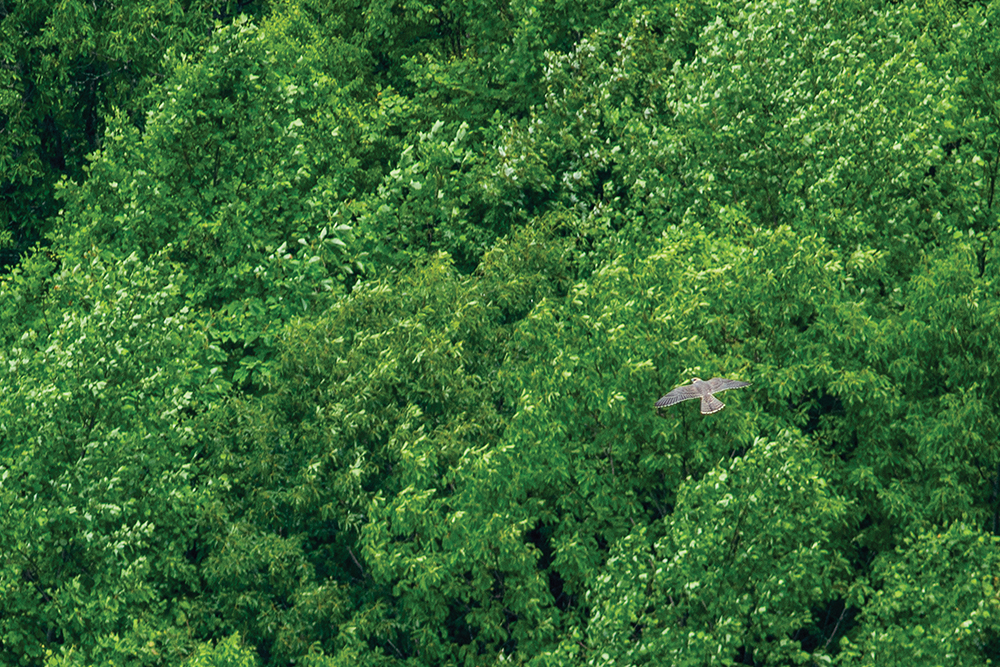
But it almost wasn’t so; the use of pesticides such as DDT in the mid-20th century nearly extirpated the Peregrine Falcon, which was listed as an endangered species in 1970 according to the U.S. Forest Service. Thankfully, following the banning of such chemicals, the birds reacted well to breeding efforts and in 1984 the N.C. Wildlife Commission began to reintroduce Peregrine Falcons into the wild and reestablish populations across the state. In 1999 Peregrine Falcons had recovered sufficiently that they were removed from the U.S. Endangered Species list.
But human activity remains one of the Peregrine’s major threats. Fortunately, partnerships between public and private organizations have been developed in western North Carolina to help mitigate these concerns; members of the Carolina Climbers Coalition proactively identify and monitor nesting sites, known as eyries, and coordinate with biologists from the N.C. Wildlife Resource Commission. The U.S. Forest Service factors this information into decisions about closing identified sites in the Nantahala and Pisgah Forests. And organizations such as the Highlands-Cashiers Land Trust protect and conserve surrounding property that provides habitat for the Peregrine’s food sources.

And the good news is that it’s working! According to the U.S. Forest Service, “in 2021 across western North Carolina, 15 sites were occupied by peregrine falcon pairs and seven successfully reproduced with a total of 12 offspring.”
So please respect any signage you encounter indicating a closure due to nearby nesting peregrine falcons, but also take the time to look for these magnificent birds in flight – and be grateful that they once again call Western North Carolina home!


Favorites Count: 0