
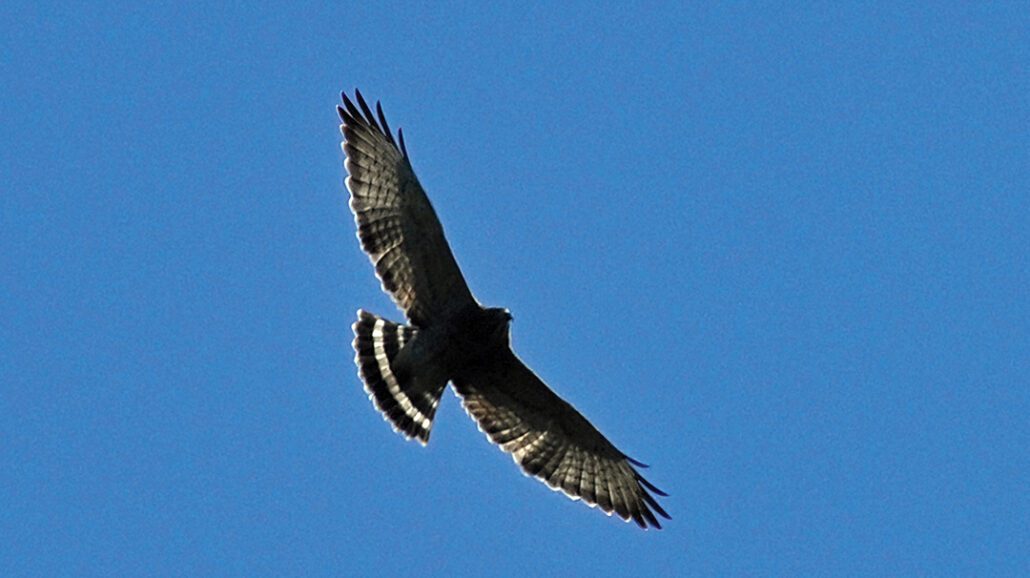
Broad Wings over the French Broad
Broad-wing Hawks (Buteo platypterus) are recognizable while soaring by their full wingspan and white tail bands. Like hawks generally, they are intelligent and highly adaptive. Their visual acuity, sharpness of vision, is astounding owing to the density of photoreceptors in their retina being five times greater than that of the human retina.
Broad-wings are skillful hunters, preying on lizards, chipmunks and voles but changing their diet as seasons and available food change. They hunt beneath the forest canopy from a high perch, diving down and seizing prey with deadly talons. They skin some prey including frogs and snakes but consume small mammals whole.
Some hawks pair-bond for life. Both male and female build the nest. The male brings food to the brooding female, takes his turn on the nest, and later feeds the hungry nestlings. The female is larger than the male.
The fall migration of Broad-wings and other raptors returning to Central and South America peaks in September.
At this time, large “kettles” form containing hundreds of migrating birds, taking advantage of favorable winds and riding thermals in huge spiraling cauldrons, reaching their highest point before individual birds peel off to soar great distances south while searching for the next updraft. On September days with clear skies and favorable wind, thousands of Broad-wings can be seen soaring through the gorges and mountains of the Great Smoky and Appalachian ranges.
You have a good chance of seeing large collections migrating. One such viewing place experienced birders go to is on top of Whiteside Mountain.
To reach good viewing spots among the plutons at the top, you have to climb a mountain. This entails strenuous hiking on a path full of protruding roots and rocks. Wear your best hiking shoes. It’s a fairly steep incline you walk for 20 minutes. The views are spectacular. You can descend by either backtracking or taking a narrow, steep trail on the other side of the mountain. If you are hardy and undaunted and reach the peak, you stand a good chance on a clear September day of seeing thousands of Broad Wings and other hawks and eagles float by on the air currents. Peregrine Falcons nest on these cliffs.
The mission of the Highlands Plateau Audubon Society is to provide opportunities to enjoy and learn about birds and other wildlife and to promote conservation and restoration of the habitats that support them. HPAS is a 501(c)(3) organization, a Chapter of the National Audubon Society. Visit highlandsaudubonsociety.org for information on membership and activities.


Favorites Count: 0