
We’ve spotlighted the bee-friendly activities of Rose Mary Achey several times over the years.
In fact, our writer Daryna Thiemann has made it her goal to don a beekeeping suit and step into the center of Rose Mary’s beekeeping enterprise – those beautiful white hives in her backyard.
I could have taken the assignment, but the thought of having hundreds of those buzzing bandits swifting past my head gives me the willies.
This natural reaction was permanently imprinted on my brain pan last year when my dog Skylar and I stepped directly upon a nest of burrowing bees. Their retaliation was immediate and targeted to our most sensitive body parts.
Wiser and sufficiently chastised, I contacted my friend Anna Gurney at the NC Wildlife Commission and she spilled the honey on the burrowing bees that surround us:
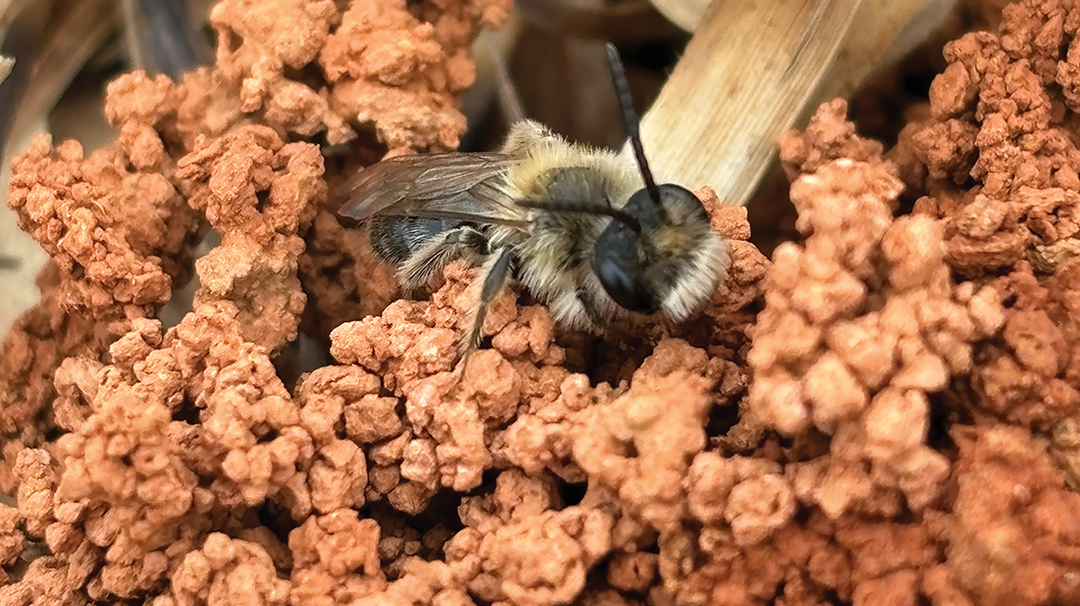
“Believe it or not, most of the more than 500 native bee species in North Carolina nest underground. (Hopefully you haven’t discovered that the hard way! Shoes are your friend when outdoors!)
“Burrowing bees are solitary insects; however, they often nest in masses, resulting in hundreds (possibly thousands!) of little burrows clustered across small areas. Some people believe the solution is to pour gasoline into their burrows or spray them with insecticides to rid them of an area. But bees provide a crucial pollinator role to our ecosystem. And there are alternatives to the “elimination route.”
“More than 80 percent of flowering plants rely on pollination services provided by wild bees. Furthermore, they contribute billions of dollars to our economy by pollinating crops. While it may be startling to see so many bees on your front lawn, here are a few facts to consider for coexisting with these ground dwellers:
Solitary bees are not aggressive. They do not have a hive or colony to defend so their inclination will be to fly away from perceived danger. In addition, only female bees can sting as males do not have the anatomical features to sting.
Most ground-nesting bees are only above the surface for a very short time. They spend most of their lifecycle below ground in some phase of development. If you’re seeing bees on your front lawn today, chances are they will be mostly gone within two-to-three weeks, not to emerge again until next year.
“Some examples of ground-nesting bees in North Carolina include mining bees (Andrena spp.), cellophane bees (Colletes spp.), and sweat bees (Lasioglossum spp.). Different species emerge at various times throughout the growing season, but many do typically emerge in the spring. They are often mistaken for other insects, including yellow jackets and even ants.
For bee questions or concerns, contact bee expert Gabriela.Garrison@ncwildlife.gov or NC Wildlife’s Helpline at (866) 318-2401.


Favorites Count: 0