
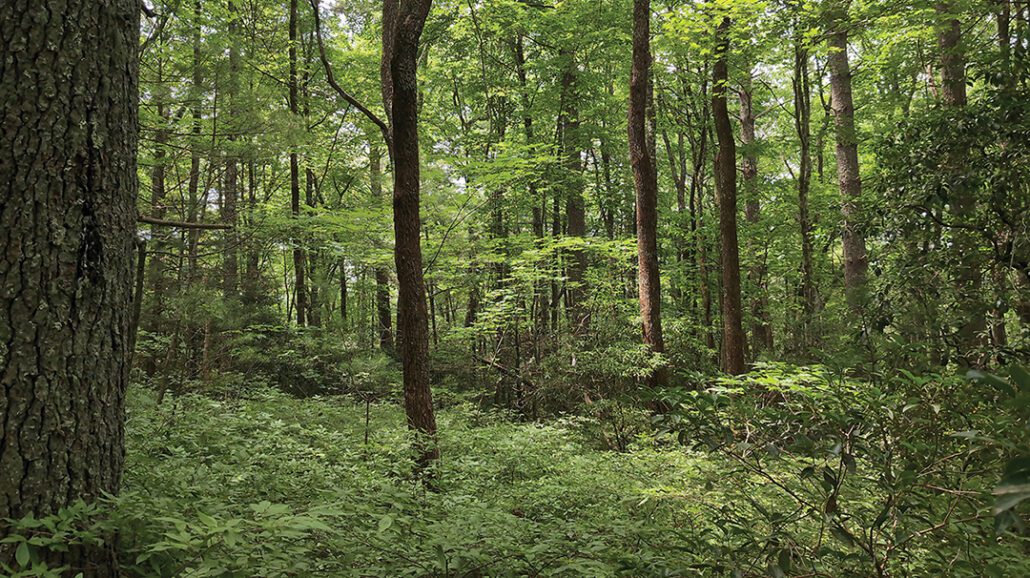
Most people are aware as they hike through our forests that they are not walking amid virgin old-growth forests; old black-and-white pictures of massive trees in the “Primeval Forest” that once covered most of the land between Highlands and Cashiers provide sad reminders of the incredible forestland that must have provided an almost ethereal experience to hikers a century ago.
With few exceptions, most of the standing timber in our area was harvested in the early decades of the 20th century, much of it ignominiously sold as pulp wood. It is understandable that the lushness of our current woods, however, can lead to a first impression that our current forests have fully healed.
However, as noted by Robert Zahner, a former professor of natural resources at Clemson, in his excellent book The Mountain at the End of the Trail, while acknowledging that after wholesale timber operations “the forest will grow back,” unfortunately while even after “a few hundred years we may have the outward appearance of a forest – we now know that a thousand years or more is required for the biota of such an ancient forest community to be restored to all its diversity, integrity, and beauty.”
Forests thrive on disturbance, such as that caused by the occasional windstorm or fire, which serve to open pockets within mature woods that allow sunlight to penetrate and nurture species that could not thrive in the shady environs of full tree canopies.
Unfortunately, however, manmade disturbances such as the wholesale timbering operations the Plateau experienced 80-100 years ago did not result in these healthy gaps but rather widespread clearing; in these types of situations tree species that replicate via wind dispersal such as tulip poplars, white pines, red maples, and sweet birch, have an advantage over other species such as oaks where reproduction is more dependent on forces such as gravity or animals.
Many forest stewards are increasingly looking to actively manage their properties to intentionally mimic the natural disturbances in canopy to foster diversity; in fact, a recent study conducting in conjunction with the US Forest Service found that such open pockets are “rich in biological legacies” because they are frequently characterized by “complex food webs” that “provide resources that attract and sustain high species diversity” and can allow a variety of tree species to reestablish.
On your next hike take time to note the tree species, including the distinctive oak, and give thanks when you see this diversity returning to our forests!


Favorites Count: 0