
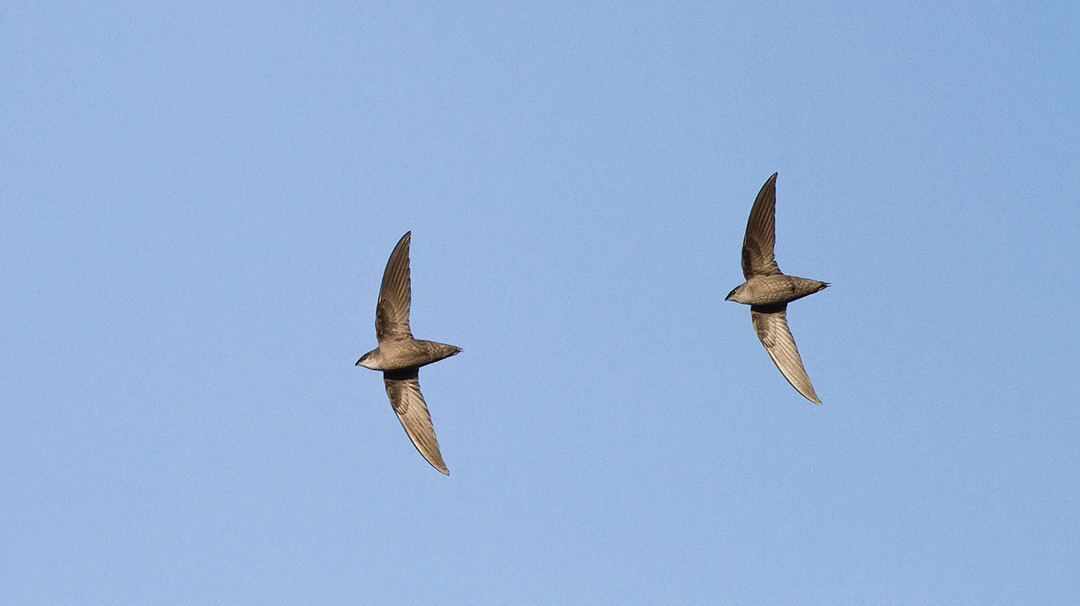
The Chimney Swift spends much of its life airborne, only ever roosting to sleep and nest. They bathe and perform courtship rituals midair, swooping down to wet themselves in a pond or bird bath, then rinsing their feathers as they rise.
They also perform a seldom‑seen courtship ritual in which a male and female form a V with their wings and fly close together, like figure‑skating partners gliding behind one another. During the day they can often be found flitting through the air over rivers and lakes where they enjoy catching insects, eating up to 12,000 in a day.
Their specialized legs don’t allow them to perch like most birds, but instead they use their long claws to hold onto vertical walls. They can roost in caves, on cliff faces, and inside hollow trees, but with the logging industry destroying much of the old‑growth forest they once called home, they adapted to roost in chimneys. This is where they got their iconic name, but their sickle‑shaped wings and blunt, short bodies earned them the nickname “The Flying Cigar.”
Unmated Chimney Swifts can roost together in groups, forming large tornado‑like flocks as they pile into a chimney. Mated pairs, however, prefer a space to themselves and will build a nest directly on the side of a wall using interwoven sticks. They adhere nesting materials to the vertical surface with their sticky, glue‑like saliva.
In the summer they can be seen in most of the eastern half of the continental United States and southern Canada. In early September, they migrate to their wintering range, the northwest corner of South America in countries such as Colombia, Brazil, Ecuador, and Peru.
The Chimney Swift has seen its population decline by 74 percent since the mid‑sixties. Much of this is due to loss of suitable roosting locations, as modern homes and buildings often don’t use the traditional brick chimneys that served as ideal roosting spots. Swifts now must rely on historic buildings and remaining old‑growth forests, which is leading local conservation groups to build swift towers. These specialized birdhouses accommodate the Chimney Swift’s unique roosting style.
The Headwaters Bird Alliance is hosting a Swift Soiree on Saturday, August 29, from 7:00 to 9:00 P.M. at the Cowee School Arts and Heritage Centerin Franklin. The potluck‑style dinner will allow birders to observe the swifts as they roost in the chimneys preserved as part of the building’s original architecture. Visit headwatersbirdalliance.org for more details about the event.


Favorites Count: 0