
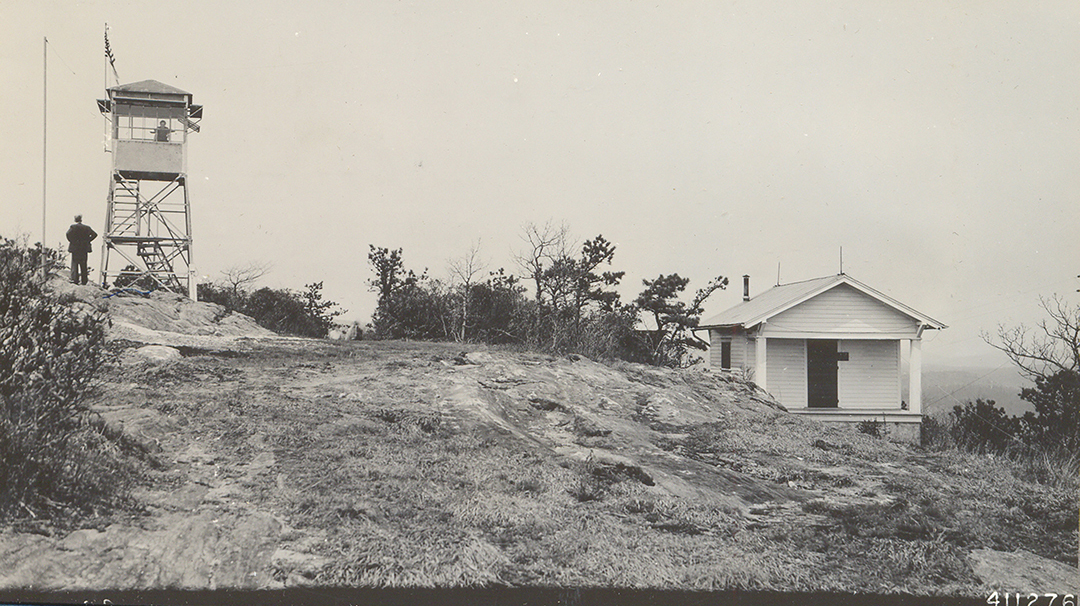
c. 1928
This space has described how, in 1909, the predecessor organization to the Highlands‑Cashiers Land Trust saved the summit of Satulah Mountain from development (November 2025). But there’s more to the story — once conserved, the mountain continued to play an important role in protecting the natural resources of our area.
At the turn of the last century, North Carolina’s first state forester, J.S. Holmes, declared that “forest fires are the greatest enemy of North Carolina’s timber resources.” Fire detection at the time relied heavily on observation, and the first tower in our area was most likely on Little Scaly Mountain, privately constructed perhaps as early as 1906. By the 1920s, fire lookout towers had become the standard detection strategy throughout western North Carolina.
In 1932, the U.S. Government leased from HCLT’s predecessor a small (1,900 ft²) plot on the top of Satulah “exclusively for…construction and use of fire detection improvements and dwelling for lookout.” The 50‑year lease required that the government’s improvements “should not interfere with the use and enjoyment of the area as a public park” and further that the area be restored to its original condition upon expiration of the lease.
While the exact construction date is uncertain, it seems that the tower was in place on Satulah by the late 1930s or 1940. Reports indicate that a 23‑foot steel tower with a 7×7‑foot cab was erected by CCC Camp F‑23 from nearby Otto, NC. Its tenure was short‑lived, apparently, as by the mid‑1950s it was listed for sale and removed.
The caretaker’s cottage continued to be used temporarily by U.S. Air Force personnel operating a radio relay station connecting Donaldson Air Base in Greenville, South Carolina, to Sewart Air Base in Nashville, Tennessee. A 1954 news article emphasized that “Christmas would probably be very cold” for the four men stationed atop the mountain.
Correspondence indicates that in 1976 the U.S. Forest Service removed the last remnants of the infrastructure (“concrete debris and metal anchors”) and successfully restored the impacted areas. The lease was terminated early, ending Satulah’s role in forest‑fire prevention and national defense.
For more information on the history of fire towers in western North Carolina, see Peter Barr’s Exploring North Carolina’s Lookout Towers with photographs by Kevin Adams.
HCLT is proud of its long history of conserving our area’s natural resources. For more information on HCLT and its activities, please see hcltnc.org and follow us on Facebook and Instagram.


Favorites Count: 0