
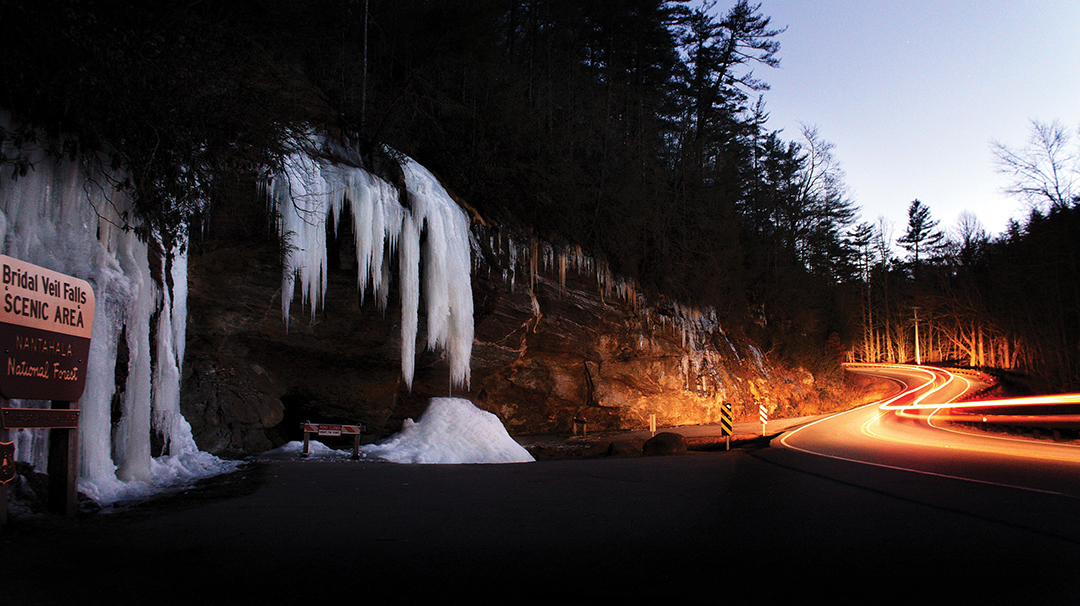
When surveying the incredible biodiversity and landscape of the Cashiers and Highlands area it may be easy to underestimate the influence that ice has played in shaping our region, but it is not hyperbole to say that without the subtle power of frozen water our area would be drastically different.
Western North Carolina was not glaciated, or covered in ice, during the last ice age, the Pleistocene Epoch, that ended approximately 12,000 years ago. But over thousands of years the southward advancing ice had pushed northern species south. When the ice eventually melted and retreated many of the species remained, as the higher elevations of the Southern Appalachians mountains provided refuges – “sky islands” – of accommodating habitats.
These relics of northern environments include the Red Squirrel, the Northern Saw-Whet Owl, and Ground Juniper. Almost 10,000 species exist in our area, and more than 250 are endemic, existing nowhere else.
Even though not directly covered in glacial sheets, the associated cold climate caused our region to experience periglacial processes, a natural phenomena that causes weathering and erosion. Innumerable freeze-thaw cycles, in which water seeps into the cracks of rocks and expands when frozen, fractures and breaks rocks into progressively smaller pieces.
Add-in the forces of gravity, and areas of large boulders, known as block fields, can be evidence of periglacial activity.
But it’s not all ancient history. Anyone that has hiked Whiteside Mountain in the winter has witnessed the incredible transformation when much of the mountain is encased in ice.
In fact, Whiteside Mountain is North Carolina’s most-popular multi-pitch ice climbing destination. And the freeze-thaw cycles continue to impact the mountain to this day; many of the “whitest” portions of the cliffs on Whiteside are the result of exfoliation, where freeze-thaw cycles have exacerbated the sloughing-off of aged, darker “skin” layers of rock.
The Highlands-Cashiers Land Trust is committed to protecting the natural resources of the Cashiers and Highlands area, and building awareness of the incredible dynamics that have shaped our landscape and resulted in our rich biodiversity. For more information on HCLT please see our website, hcltnc.org, and follow HCLT on Instagram and Facebook.


Favorites Count: 0