
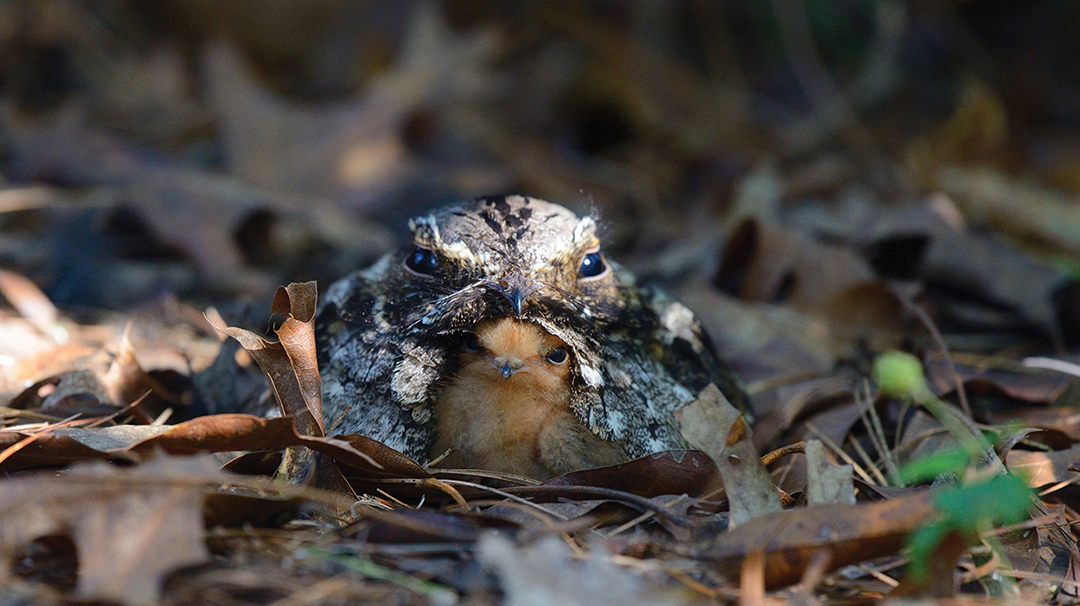
On spring and summer nights on the Highlands‑Cashiers Plateau, a seldom seen bird can often be heard singing its name, repeating the call of “whip‑poor‑will” for hours.
The call belongs to the eastern whippoorwill, which can be found almost anywhere along the east coast of North America in the spring and summer.
Whippoorwills are members of the nightjar family, and their blocky heads, long wings, and short tails give them a top‑heavy look, yet spotting them is quite the task.
They spend much of the day sleeping along the forest floor, on logs, and low branches. Their plumage of dappled brown and gray feathers gives them exceptional camouflage. During the day they may sit on a log, looking like no more than a knot of wood, or they may melt into a mess of leaves.
Whippoorwills are crepuscular, meaning they are most active during dawn and dusk. They feed exclusively on insects, and their large eyes possess a reflective structure behind their retina that helps them to see in low light. When maneuvering through the understory, their wide mouths help them capture moths, beetles, and mosquitoes midflight. Whiskers on either side of their beak help to funnel in unsuspecting prey, allowing them to consume over 1,000 insects in a night.
For much of the month they are only able to hunt during twilight and dawn, but when the moon is full, they can hunt and feed throughout the night. This plays a vital role when timing the laying of their eggs. Chicks hatch about 10 days before a full moon, allowing for an optimal feeding time for when they fledge.
Before the eggs hatch, they face more dangers than most birds. Whippoorwills are ground nesting, so in addition to predators they must contend with cattle, humans, housecats, and dogs disturbing their nests. If approached by a predator, the parent will stumble away from the nest, flapping its wings to feign an injury and draw them away from the vulnerable eggs.
Despite ranging from Florida to Canada, whippoorwills are listed as a tipping point species, having lost 50 percent of their population in the past 50 years. This is partly due to the loss of ideal habitat, their nests being vulnerable, and a decline in their primary food source, insects, due to widespread insecticide use.
Sightings used from recreational birders are vital in providing data for widespread conservation efforts. If you’d like to help whippoorwills and other native birds, get involved with the events held by the Headwaters Bird Alliance at headwatersbirdalliance.org.


Favorites Count: 0