
“All I know is just what I read in the papers . . . and that’s an alibi for my ignorance.”
– Will Rogers
The famous humorist and social commentator, Will Rogers, was most definitely not talking about the newspapers that have come and gone in Highlands over the years when he offered the above witticism.
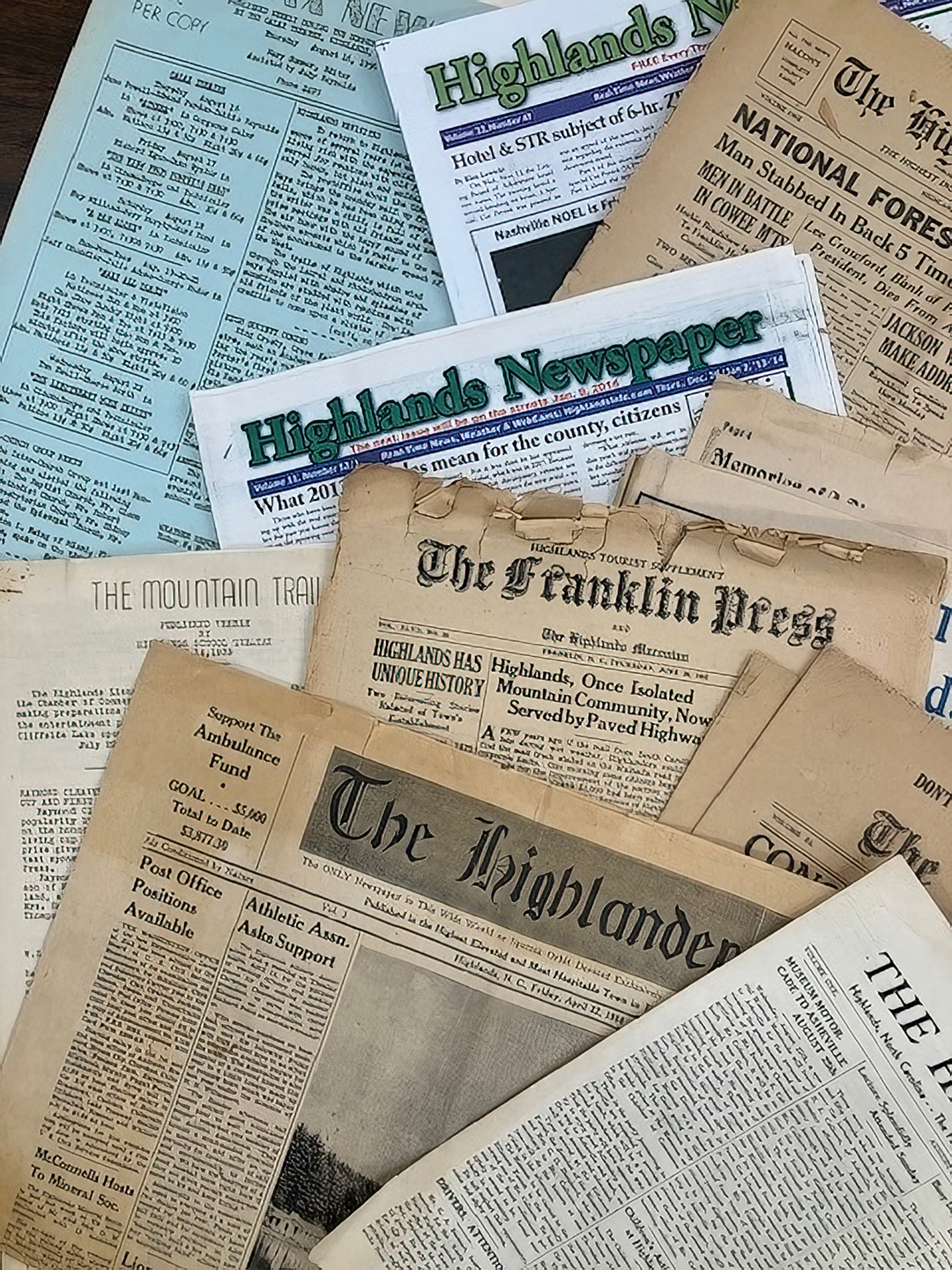
For most of the 150 years of Highlands’ existence, various newspapers have provided an important connection to the happenings in our mountain community and have kept locals and visitors alike well informed about the people, places and events central to the town.
The first newspaper published in Highlands was the Blue Ridge Enterprise, edited and published by E. E. Ewing from January 1883 to January 1885. As a former publisher from Topeka, Kansas, Ewing’s four-page weekly paper focused on town news, local and national non-partisan politics, editorials and advertisements. A yearly subscription for the paper cost a reader $1.50, payable in advance.
An early 1883 editorial illustrates the fact that the focus and humor of the citizenry has not changed much over the years.
Commenting on the poor condition of the town roads after heavy rains, Ewing wrote, “A line of ferry boats should be established at some of our street crossings for the accommodation of the public. In some places the water and mud is too deep to ford during the rainy spells, and as we are not all swimmers, drowning accidents are liable to occur.”
Ewing sold the paper to Albert Clark after only four months and Clark moved the printing operations to a new office on 4th Street near where the bridge over Mill Creek exists today.
The second paper in Highlands was the first iteration of The Highlander, which was established by Richard Goldie in August 1885.
He wrote in his first editorial that, as a Southern journalist, he would be civil and respectable in contrast to the Northern style of “dirt throwing, and everlasting dirt throwing, which some papers indulge in.”
Goldie’s reign over the newspaper ended four months later when he sold the paper to Minnie Clark, Albert’s wife, and a group of leading Highlands’ citizens. She began to publish an eight-page paper at the bargain price of $1 a year, payable in advance, or an alternative price of “six or eight chickens, or as many dozen eggs, two bushels of potatoes or apples, seventy bundles of fodder…and anyone of these will give you eight pages of good reading every week for a year, 416 pages in all.”
Clark ended her publication in February 1887.
No paper was published in Highlands until brothers William and Charles Coe began publishing The Star in May 1890. Due to its one-sided opinions about several controversial topics – including a railroad coming to Highlands – the Star shut down in June 1891. The Coe brothers did manage some good by publishing an attractive promotional pamphlet called In the Heart of the Mountains, copies of which remain today.
A fourth newspaper simply called Number Four was published for four weeks by a group led by schoolmaster Thomas A. Harbison, which was later replaced by the Mountain Eagle, which ceased publication in 1893.
Highlands was then without its own paper until 1930, although a feature column about Highlands was consistently written in the Franklin Press by Baxter White and others.
Jack Moore and Jim Street, who had both been working for the Franklin Press began publishing Highlands’ sixth newspaper, The Highlands Maconian, in September 1930, from offices behind the Rock Store at the corner of 4th and Main Streets.
Economic pressures brought on by the Great Depression resulted in the two papers combining as the Franklin Press and Highlands Maconian with the resulting paper focusing mainly on the news of Franklin, though a weekly Highlands column appeared until 1956.
Interim years saw publication of a new Highlander for five issues in 1937, followed by The Mountain Trail, from 1938 until 1952, and then the Galax News from 1952 until 1971.
While still in high school, Mary Summers created the paper, which was printed in the back of her father’s Galax Theater on Main Street. Sold for 5 cents a copy, the Galax News was originally printed as a seven-page mimeographed paper that grew to 30 mimeographed legal sheets twenty years later.
The Highlander’s latest incarnation was founded by Jim and Martha Goode in May 1958 as Highlands’ 10th paper by most accounts. Sixty-seven years later it’s still published weekly today.
Less than a year after the paper was established, Jim died, leaving Martha as publisher and editor operating out of her living room.
In 1970 she retired, leaving the paper to Helen Holt Hopper who helped the paper thrive and grow into a twice-weekly jewel with multiple columnists focused on local news.
Reflecting on her work, Hopper recalled “Sometimes it was easy to write, sometimes it was just nerve wracking. At times I was tempted to jerk the phone loose from the wall.”
Though it has since gone through many ownership, staffing and editorial changes over the years, and it has been altered stylistically from time to time, The Highlander continues to connect locals and visitors alike to the events happening on the Plateau.
In July 2003 Kim and Jim Lewicki first published Highlands Newspaper as Highlands’ first free paper and it has been published weekly and in full-color ever since. Focusing on the people of Highlands, its government, school and businesses, the paper now prints over 5,000 copies per week and is distributed throughout the Plateau and beyond. Riding the wave of new technology, the paper can also be read, in full, online.
For almost 150 years, keeping the people of Highlands informed was the central tenet of each newspaper that once existed in Highlands, a legacy that continues today. In Highlands, there has never been a need for an “alibi for ignorance”.
The Highlands Historical Society is closed for the season and will re-open in May. Please visit our website at highlandshistory.com to see our online exhibits and learn more about the history of Highlands from the comfort of your own home.


Favorites Count: 0