As late summer gives way to fall on the Highlands-Cashiers Plateau, you may experience a few more encounters with some of nature’s less-favored residents: spiders.
The spider life cycle often begins with eggs hatching in the spring, allowing spiders to feed and grow throughout the summer. Some of the most common spiders you’ll see during the Halloween season belong to the orb-weaver family, which includes the bright orange Pumpkin Spider, also known as the Marbled Orb Weaver, and the black, spiny-bodied Spined Micrathena.
Orb-weavers are admired for their intricate webs, which catch both sparkling sunlight and our collective awe at nature’s beauty. Beyond their impressive craftsmanship, they are highly skilled hunters capable of consuming up to twice their body weight in insects each day. In this way, orb-weavers help maintain ecosystem balance by providing natural pest control.
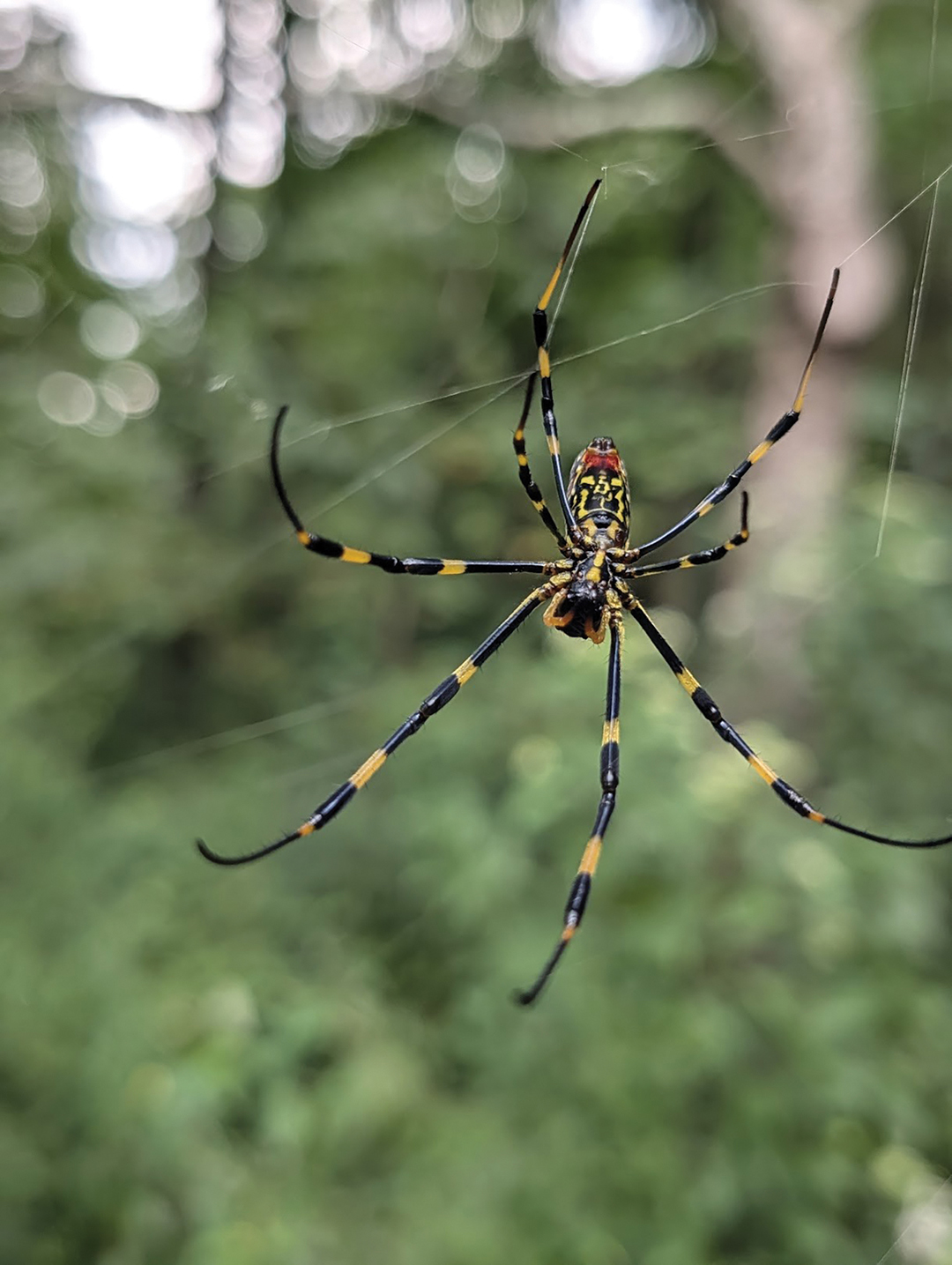
While there are about 180 species of orb-weaver spiders native to North America, some spiders appearing on the Plateau may be a newly invasive species called the Joro spider.
Native to parts of Asia, the Joro spider first appeared in Georgia in 2014, likely arriving through shipping containers or potted plant materials. Since then, its range has expanded across the southeastern United States and into the forests of the Highlands-Cashiers Plateau. Like native orb-weavers, the Joro spider reaches adulthood in late summer and begins constructing larger webs.
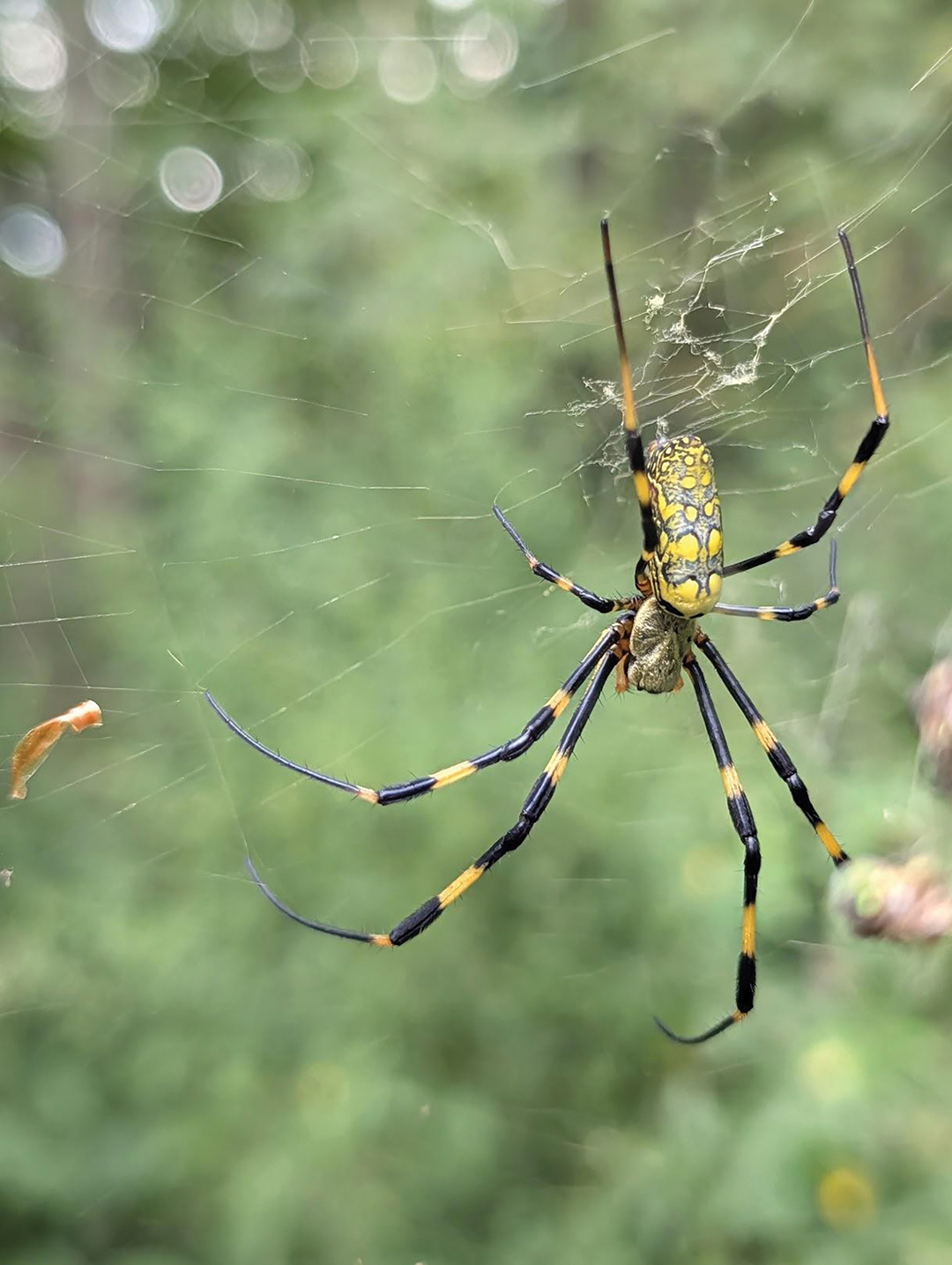
Male and female Joro spiders differ dramatically in appearance. Males are relatively small, with dull light-brown coloration, darker markings on their legs, and a dark stripe running down the abdomen. They typically measure just 0.2 to 0.3 inches in body length, with leg spans of about 1 to 1.5 inches.
Females are far more conspicuous. Their legs feature bold striping, and their abdomens display striking yellow-and-black patterns. Female Joro spiders can reach a body length of up to 1 inch and a leg span of up to 4 inches, making them hard to miss during September and October.
While the terms “non-native” and “invasive” often raise concerns, researchers have not yet fully understood the ecological impacts of increasing Joro spider populations. Reports have documented highly concentrated populations in certain locations, but their relationship with native spider species remains unclear.
To help scientists track the spread of Joro spiders, researchers encourage participation in citizen science projects such as iNaturalist.
The mission of the Highlands-Cashiers Land Trust is to protect our unique and irreplaceable biodiversity. For more information, visit hclt.org and follow HCLT on Facebook and Instagram.


Favorites Count: 0